Next
You'd never let three spokespeople give three different versions of the same official statement. Yet that's what happens across many organisations' websites, apps and portals every week, because each one is updated separately.
For a government entity and multinational, that's a credibility problem. For an enterprise, it's where customers and investors size you up, often before they've spoken to anyone on your team.
In the Middle East, the stakes are higher. Data often has to stay in the country, every site needs proper Arabic and English, and every change needs a record of who made it and when.
That's why we recommend Strapi for enterprise and government projects. It's an enterprise headless CMS, which means you keep all your content in one place and it shows up on your website, app and portal at once, while your data stays private and under your control.
As a Strapi Enterprise partner, tentwenty has delivered Strapi for national initiatives, healthcare providers, multinationals and large governmental organisations in the Middle East. Having a credible portfolio has given us a clear view of where Strapi works well, and that experience is what this blog is based on.
Here's what we've learned.
TL;DR
Strapi for Enterprise & Government: Is It a Good Fit for Large-Scale Organisations?
Yes, if you need control over data residency, publish bilingual content and run several channels from one place. Strapi is open source and runs on your own servers, which suits ministries, regulators and large companies in the Middle East. You'll just need a skilled team or a partner to run it smoothly.
What Do GCC Enterprises and Government Entities Need From a CMS?
In the region, three needs usually decide the choice of a headless CMS for government and enterprise teams.
1. Data that stays in the country. Government bodies and regulated sectors often must store content and user data on local servers. A CMS that can't run inside the UAE or Saudi Arabia is ruled out early.
2. Managing Arabic and English content. Arabic can't be an afterthought. It needs its own right-to-left (RTL) layout, its own search optimisation and the same care as English.
3. A clean security review. IT teams will ask who can access what, how data is protected, what gets logged and how updates happen. The CMS needs clear answers.
RTL stands for right-to-left. Arabic is read from right to left, so an Arabic website has to flip too: the menu, buttons and text all start on the right side of the page instead of the left.
There Are Three More Needs That Arise Over Time:
1. Approval before publishing. One wrong post can cause real trouble. Your CMS should let the right people check and approve content before it goes live, and show who approved it.
2. Connecting to other systems. Your website often needs to work with other tools, like a booking system or UAE Pass and Nafath logins. A good CMS makes this easy to set up and easy to change later.
3. Long-term support. Most enterprise platforms stay live for five years or more. They need regular security updates, new features and fast fixes, ideally from a local partner in your time zone.
Strapi can meet each of these needs. The rest of this guide shows how.
How Does Strapi Meet Government and Enterprise Needs?
1. Full Control Over Where Your Data Lives
“Can Strapi keep our data safe inside the UAE or Saudi Arabia?” This is the most frequent question that we get asked whenever working with large-scale organisations.
In most cases, the answer is a simple yes.
Both the UAE and Saudi Arabia have personal data protection laws, and many government and regulated projects must keep data inside the country.
Many subscription-based CMS (Contentful or Storyblok) platforms store your content on the vendor's own servers, often outside the region. That can stop a project at the security review stage, and it's one of the biggest differences when weighing Strapi vs Contentful for Gulf projects.
Strapi is self-hosted. We can deploy it on a UAE or Saudi data centre, a local cloud such as Microsoft Azure UAE North, AWS Middle East (UAE), Oracle Cloud Abu Dhabi or Google Cloud Dammam. You can also use a government-approved data centre or your own servers.
Either way, your content, database and code, everything stays on servers you control.
For the SHF Foundation, we built the UAE Year Of and UAE Pavilion Expo 2025 websites on Strapi. Both were hosted on UAE-based servers from day one, exactly as the client required.
In Brief: You can run Strapi on any server you choose, so all your content and files stay in the country from the beginning.
What the rules say in each country
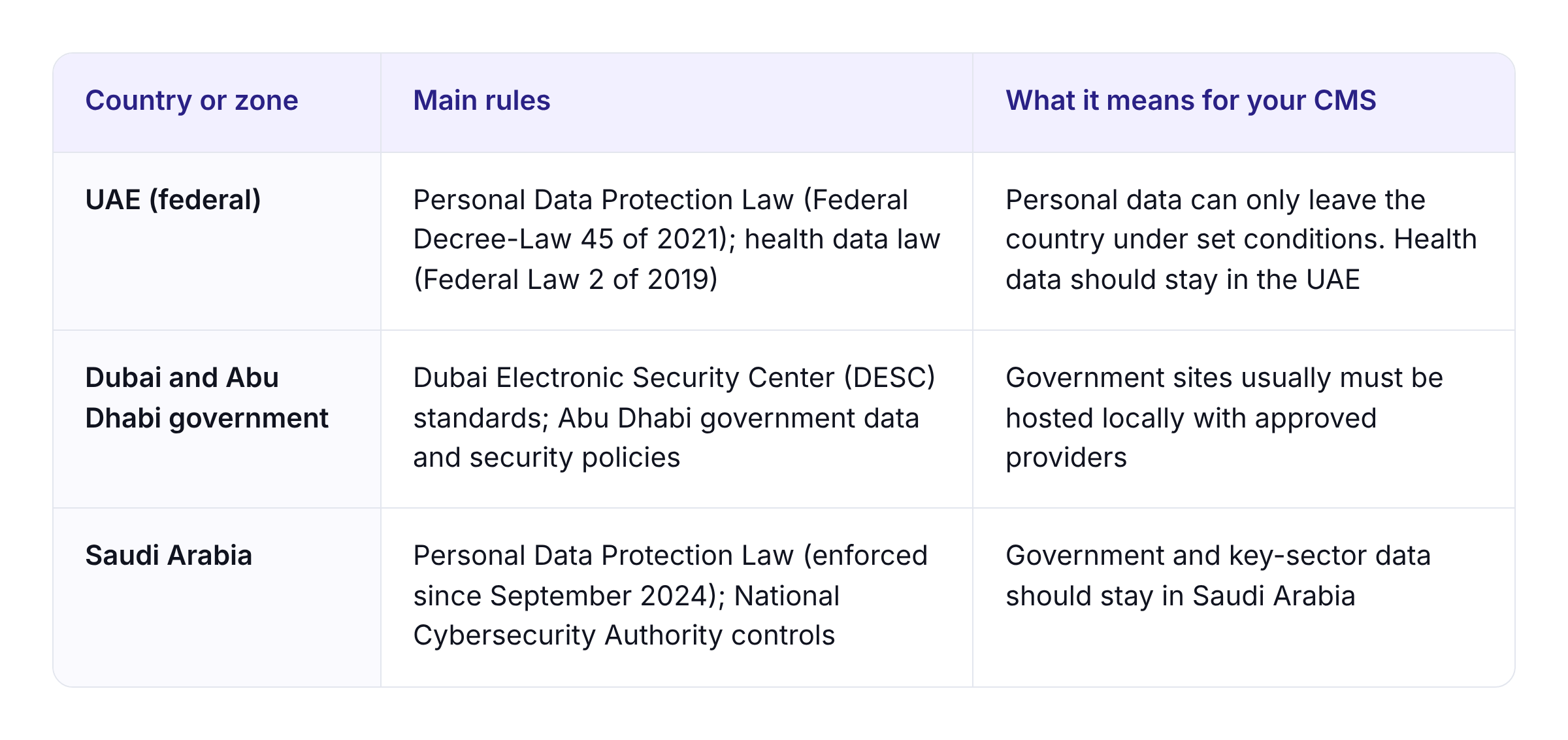
This table is a general guide, not legal advice. Check the rules for your sector with your legal team.
2. Full Control Over Bilingual Content
On other CMS platforms, Arabic is added later through a plugin. The result is broken right-to-left (RTL) layouts, missing pages and Arabic content that falls out of step with English.
On Strapi, any page or content type can have English and Arabic versions. Editors switch between them on the same screen, so it's easy to spot a page that's missing in Arabic. You can also choose which fields are shared, such as images or prices, so they only need updating once.
Right-To-Left Layout on the Website
We build the Arabic layout alongside the English one. Menus, forms, icons and tables flip correctly from right to left, and Arabic text gets its own sizing and spacing. We test both languages equally before launch.
Getting Both Languages Found on Google
Each language gets its own web address (such as /en/ and /ar/), its own page titles and descriptions, and tags that tell Google which version to show to whom. We research Arabic keywords separately, because people don't search in Arabic the way a direct translation suggests.
In Brief: Strapi supports more than one language out of the box, including Arabic, and we build the Arabic site properly from the start.
3. Will Strapi Pass a Government Security Review?
Yes, if it's set up the right way. Strapi has strong security features built in. To pass the review, it also needs to be hosted in the right place and set up correctly.
Here are the eight points we prepare on every regulated project.
01 Local hosting. Everything is stored in an approved data centre in the country.
02 Encryption. All data is encrypted, both when it's sent and when it's stored, including backups.
03 Role-based access. Each editor and department sees only the content they own.
04 Work-account login. Staff log in with their existing work account (Enterprise edition).
05 Change records. Every change and login is recorded with who did it and when (Enterprise edition).
06 Protected editing area. The editing area sits on a separate address that only approved networks can reach.
07 Updates and testing. Strapi is updated on a fixed schedule, and we run security testing before launch.
08 Backup and recovery. Regular, tested backups and an agreed plan to get back online fast.
The Right Strapi Edition for Enterprise and Government
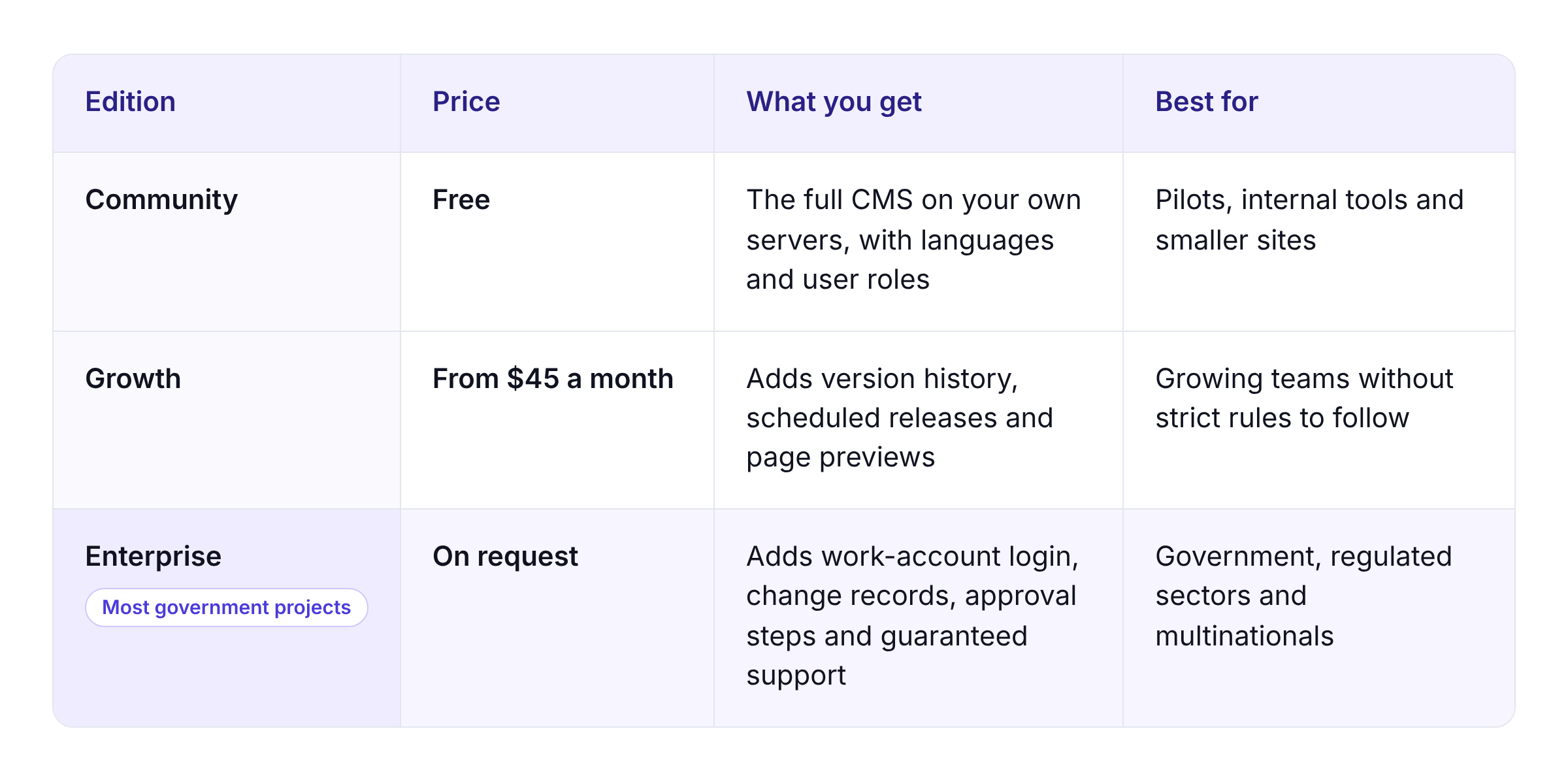
You'll usually need Enterprise if staff must log in with their work accounts, every change needs a record, content needs approval before going live, or your IT team needs guaranteed support.
Prices are from Strapi's website at the time of writing.
Strapi Implementation Plan for Government and Enterprise in the UAE
As a Strapi development company in the UAE, we take every project through six steps, so big decisions on hosting, language and security happen early, when they're cheapest to get right.
01 Discovery. We learn your channels, teams, hosting rules and which systems Strapi must connect to.
02 Architecture and hosting. We pick where to host, which Strapi edition to use and how to keep it fast and safe.
03 Content planning in both languages. We plan how content is organised and approved, in both English and Arabic.
04 Build. We set up Strapi and build the website, with the Arabic layout in place from the start.
05 Testing and security review. We test everything, including security and accessibility, and prepare what your IT team needs to sign off.
06 Launch and support. We go live, train your editors and keep the platform updated and monitored.
Moving from an old CMS? We review your current content, point every old link to its new page and move content in stages, checking as we go. This protects your Google rankings, and your team never loses access to live content.
Why TenTwenty Always Recommends Strapi
TenTwenty is a Strapi Enterprise Partner, one of only three serving the UAE. We don't just recommend Strapi. We trust it enough to run our own website on it.
We build with the same tools Strapi is made with (Node.js, Next.js, React and TypeScript). So the people who set up your CMS and the people who build your website work as one team, from day one to long after launch.
We've also built custom features on Strapi that go far beyond basic publishing:
- A booking system for Expo 2020 Dubai
- A drag-and-drop form builder for editors
- An Arabic and English translation tool, used on Forbes Middle East and The Climate Tribe
- Secure login for member and staff portals
At tentwenty, we did this for Almadallah Healthcare. Their website, web portal and mobile app now run from a single Strapi setup, and one update reaches all three channels at once.
We recommend Strapi most for:
- Government and semi-government entities with data hosting rules
- Enterprises running a website, app and portal from the same content
- Multinationals with regional teams publishing in Arabic and English
- Organisations that want to own their platform and avoid vendor lock-in
Start With the Right Foundation
Choosing a CMS is not just a technical decision. It shapes how safely you store data, how fast your teams can publish and how much you will spend over the next five years.
Whether you choose Strapi for enterprise or another platform, getting it right at the start is far cheaper than fixing it later.
If you are planning a new platform, or your current CMS is holding you back, we would be happy to talk it through. Tell us about your hosting rules, your languages and the channels you need to support. We will share how we would approach it and give you an honest view of whether Strapi is the right fit.
About TenTwenty
We work with government entities, enterprises and multinationals across the UAE, Saudi Arabia and the wider GCC, from our offices in Dubai and Riyadh.
Our door is always open for a coffee and a conversation.
Book a consultation with the tentwenty team
To see how we approach website design and development for large organisations, including Strapi CMS development services, visit our services page.
Frequently asked questions
Is the free Strapi edition enough for a government project?
Usually not. If staff need to log in with work accounts, or you need change records and approval steps, you'll need Enterprise. Budget for it from the start so you don't hit a wall halfway through.
Why Strapi Cloud isn't the answer for Gulf data?
Strapi Cloud is Strapi's own hosting service. It saves time, but right now it has no servers in the UAE or Saudi Arabia. If your data must stay in the country, that rules it out. Until that changes, hosting Strapi yourself is the way to go.
When should we decide where to host Strapi?
First, during discovery. Where you host affects your security setup, your costs and your timeline. Leave it until the end and you may have to redo work or delay launch while you wait for approval.
Is Strapi backend or frontend?
Strapi is a backend. It stores your content and sends it to your website, app or any other channel. The part visitors see is built separately, usually with Next.js. This means you can redesign your website without touching your content.
Is Strapi still a good choice in 2026?
Yes. Strapi 5 made it faster and easier to work with, and it's still one of the most popular open-source headless CMS platforms. Its well-organised content also makes it easier to add AI search and assistants, which we help with through our AI consultancy.
Is Strapi better than WordPress for large organisations?
For projects with several channels, two languages or strict rules, usually yes. WordPress is built for single websites and relies on many plugins. Strapi sends content to any channel and has fewer parts to secure. For a simple marketing site, WordPress can still be quicker.
Does Strapi support single sign-on (SSO)?
Yes. With the Enterprise edition, staff can log in with their existing work account, such as Microsoft or Okta. For website and app visitors, every edition supports logins like Google or Apple, and we can build secure member portals on top.
Can Strapi replace an old CMS?
Yes. We regularly move organisations from WordPress, Drupal, Sitecore and custom systems to Strapi. We plan your content first, move it in stages, point old links to new pages and check each step. Your team can keep publishing on the old site until the switch.
How long does a Strapi project take?
Most enterprise Strapi projects take three to six months from discovery to launch. A simple two-language website can be quicker. A platform that runs a website, app and portal takes longer. We confirm a firm timeline after discovery.